

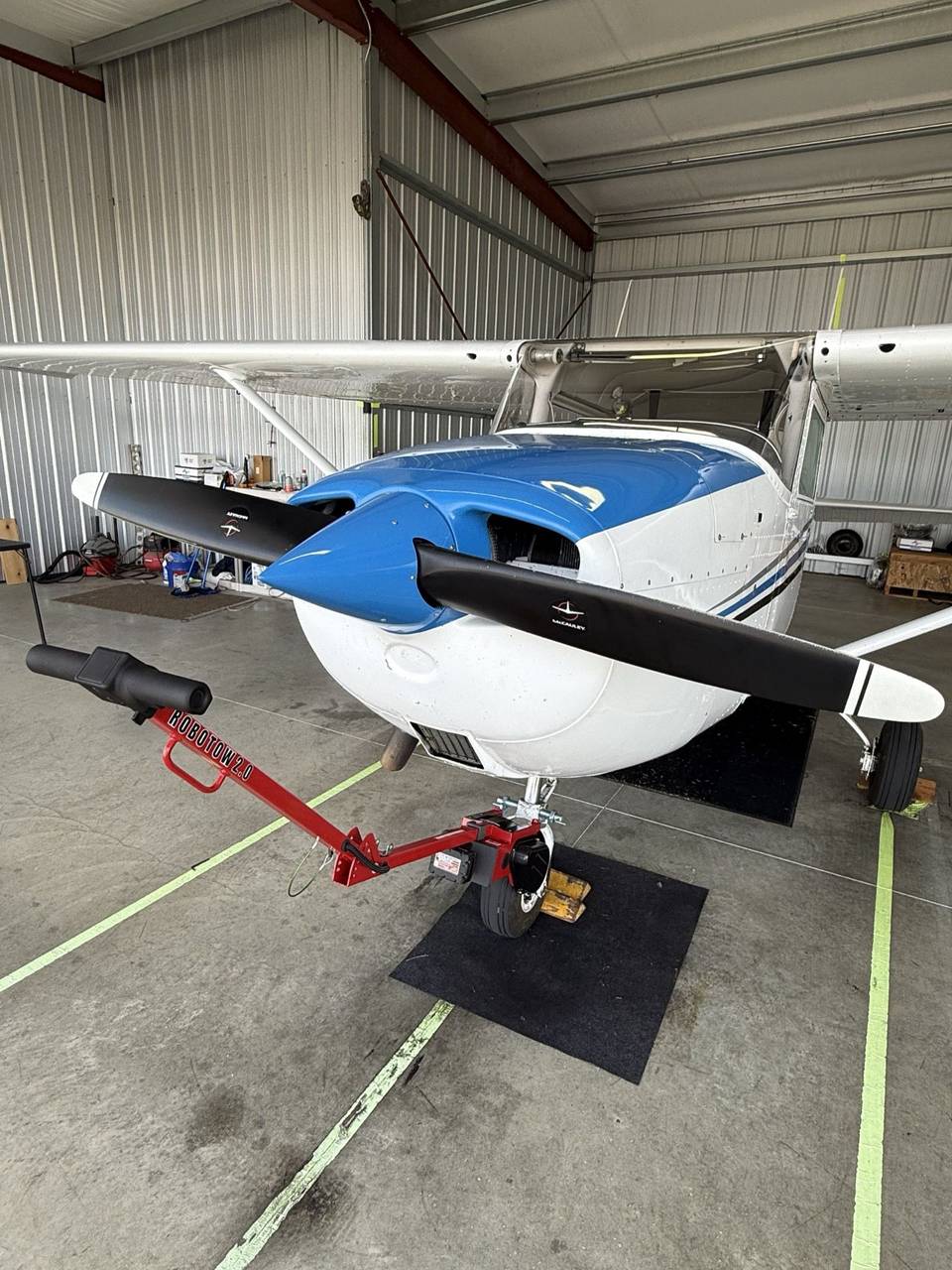
Robotow 2.0 powered tow bar for airplanes
The last twenty feet, by yourself.
A handheld electric aircraft tug. The incline, the lip, the door tracks: tell us what you fly and see if it fits.
Rather talk it through? 419-331-0371Mon to Fri, 8:00 to 4:30 ET
You get a fit answer before you see a price.
30-Day Guarantee
Not Satisfied? Return it within 30 days of delivery for a refund, includes shipping and no restocking fee. How returns work
Rather talk it through? 419-331-0371Mon to Fri, 8:00 to 4:30 ET

The last twenty feet
Flat ground was never the problem.
You can push it all day on the level. Then comes the incline into the hangar. The lip at the door. The door tracks. Full fuel. Nobody around to help.
Read more
So you take a running start. A running start is how a wingtip finds the hangar door.
Robotow drives the nose tire. You walk at the nose wheel with both hands on the handle, and you steer the nose wheel yourself. One 5Ah battery took a Cessna 172N about 2,000 feet on a flat taxiway, in one test.
Pilots say it the same way. Getting the airplane out is easy. Putting it back up the incline is the two-person job, with a running start.
How it works
It drives the nose tire. You hold the handle.
-
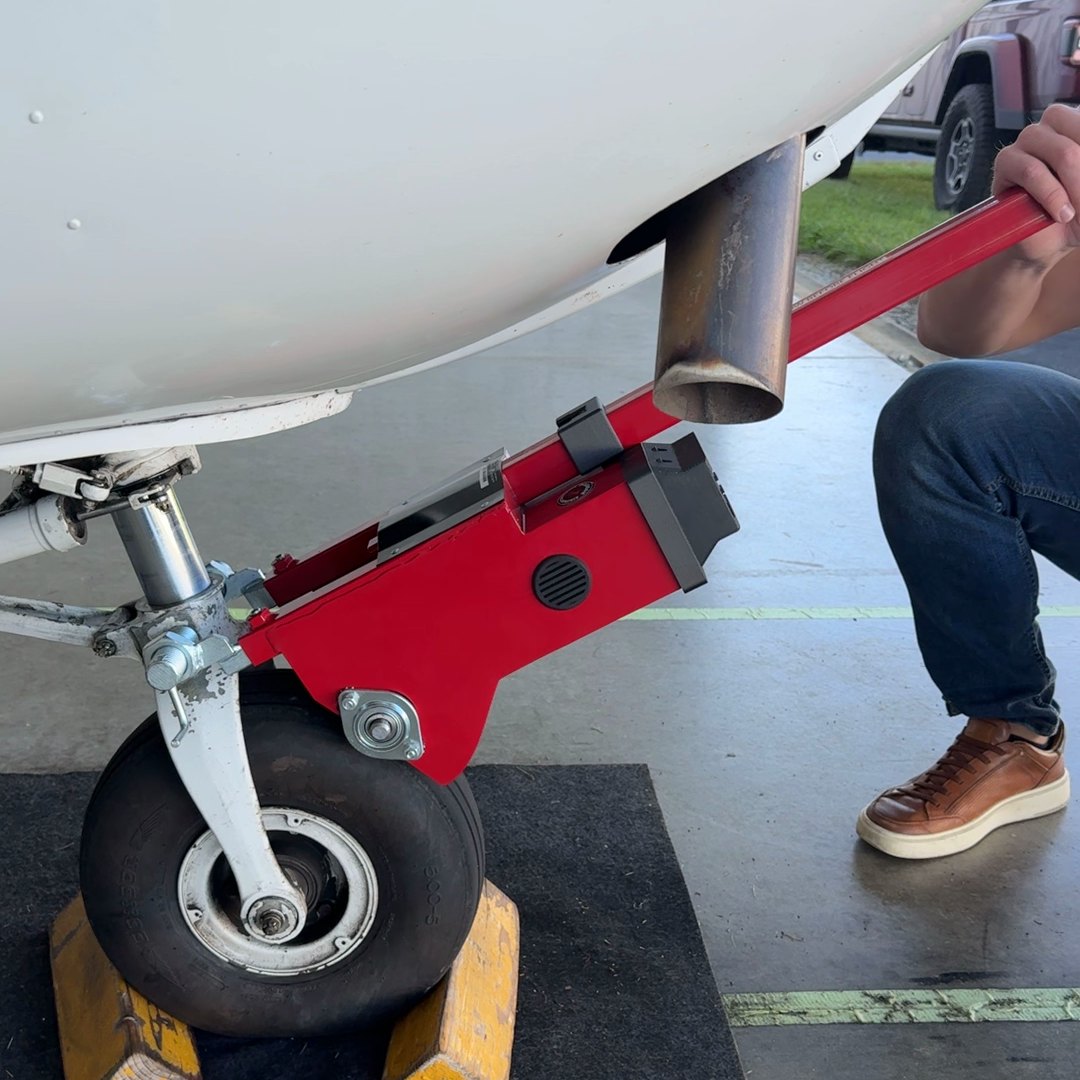
Step 1: Hook up.
An adapter made for your nose gear connects the tool to the airplane. A light at the adapter comes on, so you can see the hookup in a dark hangar.
-
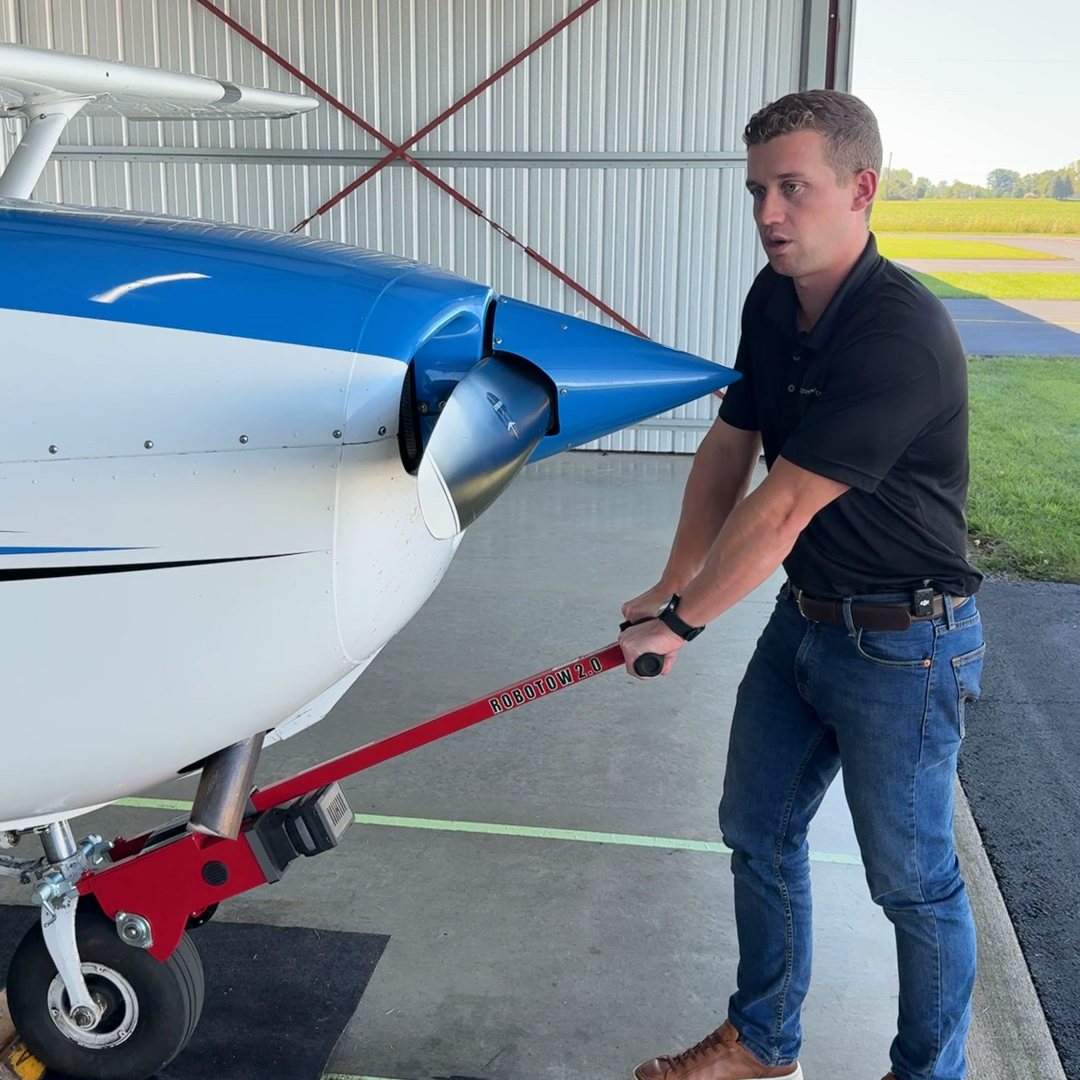
Step 2: Squeeze and lean.
Pull the trigger slowly while you keep firm down pressure on the nose wheel. The drum grips the tire.
-
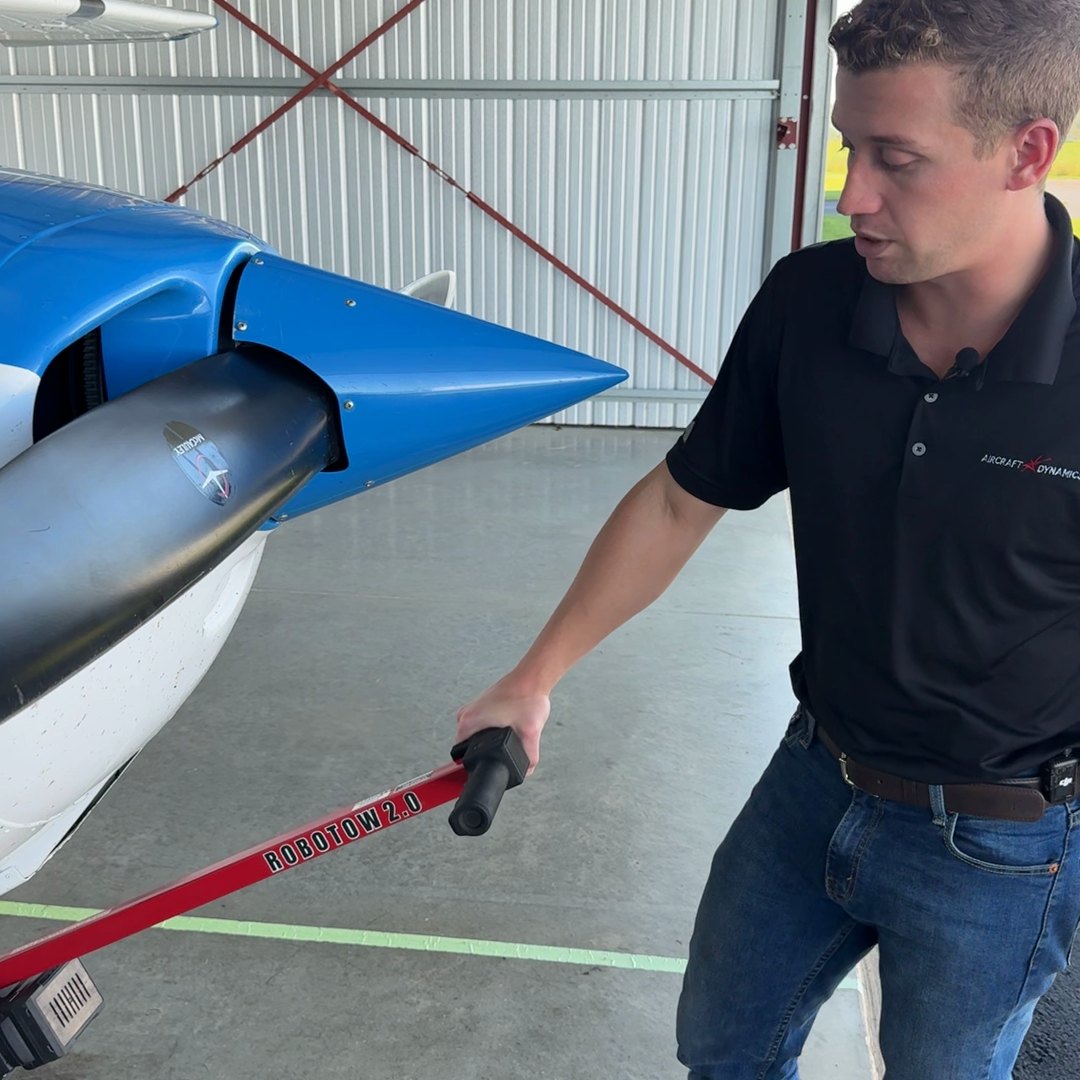
Step 3: Steer.
Turn the handle and the nose wheel turns with it. You walk at the nose wheel with both hands on the handle, and you steer it yourself.
From the manual
How to use it
-
Check for power first.
Pull the trigger with the drum off the tire. Against the tire it can take rubber.
-
Lean on it.
Keep firm down pressure so the drum stays in contact. Do not be afraid to push down firmly.
-
Door tracks and rails.
Cross at a slight angle, one main tire at a time.
-
Cold day.
Run the unit free for 30 to 60 seconds so the battery warms up.
From the Robotow 2.0 instructions, revised August 2026.
Robotow 2.0 · What it has moved
-
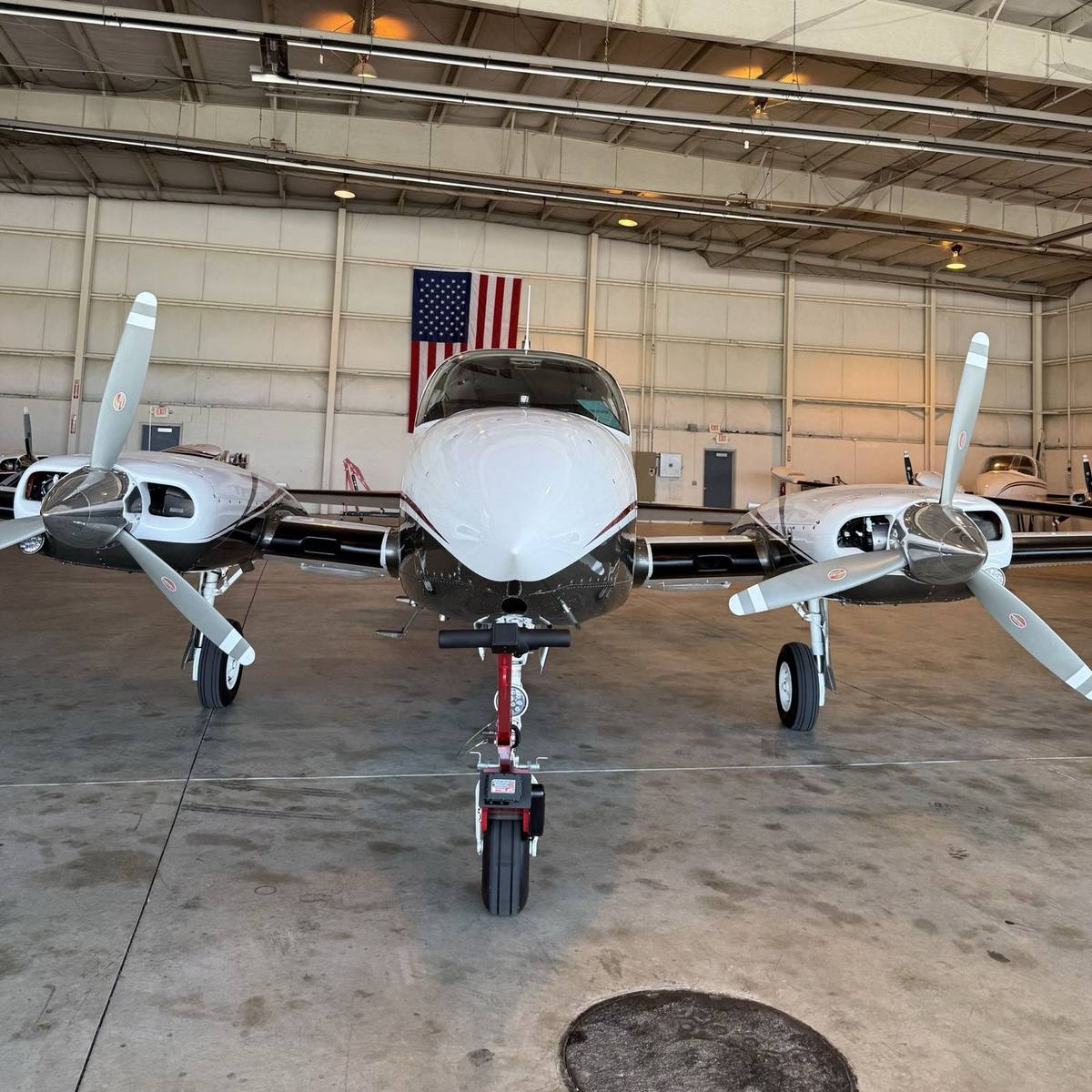
Cessna 310RG · Hangar lip Over a hangar lip, on the Pro frame. Lima, Ohio, August 2026. Aircraft Dynamics test. -
Cessna 172N · About 2,000 ft About 2,000 feet on one 5Ah battery, flat taxiway, one test. Roanoke, Texas, May 2026. Aircraft Dynamics test. Photo: a Robotow Pro on a Cessna 172K. -
Beechcraft Baron · About 5 percent grade At full fuel, up a twisting grade of about 5 percent, on a 94 degree day. Standard 2.0 frame. Marble Falls, Texas, April 2026. Aircraft Dynamics test.
Your ramp
Try it on your own ramp.
Your ramp is the only test that counts. Your incline, your lip, your airplane with full fuel.
What it does, and where it stops. Robotow drives your nose tire with a knurled steel drum while you walk at the nose wheel and steer. On ice or packed snow the drum can slip or ice over. With a wheel pant on the nose wheel, it does not fit until the pant comes off. We don't publish a slope or weight limit: ramps, lips and airplanes vary too much for one number. Tell us your airplane and your ramp, and we will talk it through.
Before you buy
What it will do, and what it will not.
A drum on a tire has limits. Ice and packed snow are two of them, and a wheel pant on the nose wheel keeps it off the tire. We say so on the kit page, in the same words every time.
The numbers
Numbers over adjectives.
- Weight, standard frame
- 23.5 lb
- Without the battery.
- Weight, Pro frame
- 27.25 lb
- Without the battery. Folds, with a carry handle.
- Motor
- 18 volt
- High-torque and brushless. Runs on Milwaukee M18 batteries.
5Ah battery: about 2,000 ft on a Cessna 172N on a flat taxiway, one test, Roanoke, Texas, May 2026.

Pro frame
The Pro folds.
Pull the release pin and the Pro frame folds to 35.75 inches. Pick it up by the carry handle. 27.25 lb without the battery.
Read more
Every airplane that fits the standard frame also fits the Pro. Pro kits from $2,869. If your airplane fits the standard frame, order the Pro by phone.


From owners of earlier Robotows
Owners of earlier Robotows, by airplane.
The 2.0 is new. Owners of the models before it have written about theirs on the pilot forums for years. What comes up most: it takes the push out of the incline and the hangar lip, the hookup takes a few tries to learn, and it can slip on a wet or icy ramp.
Where to read them
Read what they wrote on Pilots of America and MooneySpace. Reviews of the 2.0 go here, by airplane, as they come in.

Who builds it
Aircraft Dynamics, Lima, Ohio. One family since 1962.
How it started
The way the family tells it, a Lima businessman named Bill Glover slipped on ice in the early 1960s, moving his Piper Cherokee out of the hangar. He asked Jack Jones for a better way. Jack's answer was to drive the airplane's own nose tire.
Max and Carter Jones, the third generation, developed the Robotow 2.0 with the Aircraft Dynamics team. The 2.0 is designed, fabricated, assembled and tested in Lima, Ohio. We bend and weld the steel in our own shop, and every unit runs on our resistance test stand before it ships: forward and reverse at maximum power, against a nose tire.
There were probably 14 leading up to it. We call it 2.0 because it is the second iteration of this century.
Max Jones, CFO, Aircraft Dynamics

Already own a Robotow?
Your adapter fits the same frame style on the 2.0.
Straight handle to the standard frame. Pro to Pro. Short frame to short frame. Not across frame styles.
What do you fly?
Find your airplane and get a fit answer before you see a price.
Talk to the people who build it.
419-331-0371Monday to Friday, 8:00am to 4:30pm Eastern
We would rather answer the question now than ship the wrong adapter.